Training guide
Log Press Technique: Clean, Rack, Dip, Drive, and Lockout
Break the strongman log press into a stable clean, rack, dip, drive, and controlled lockout, with clear equipment and drop-area safety.
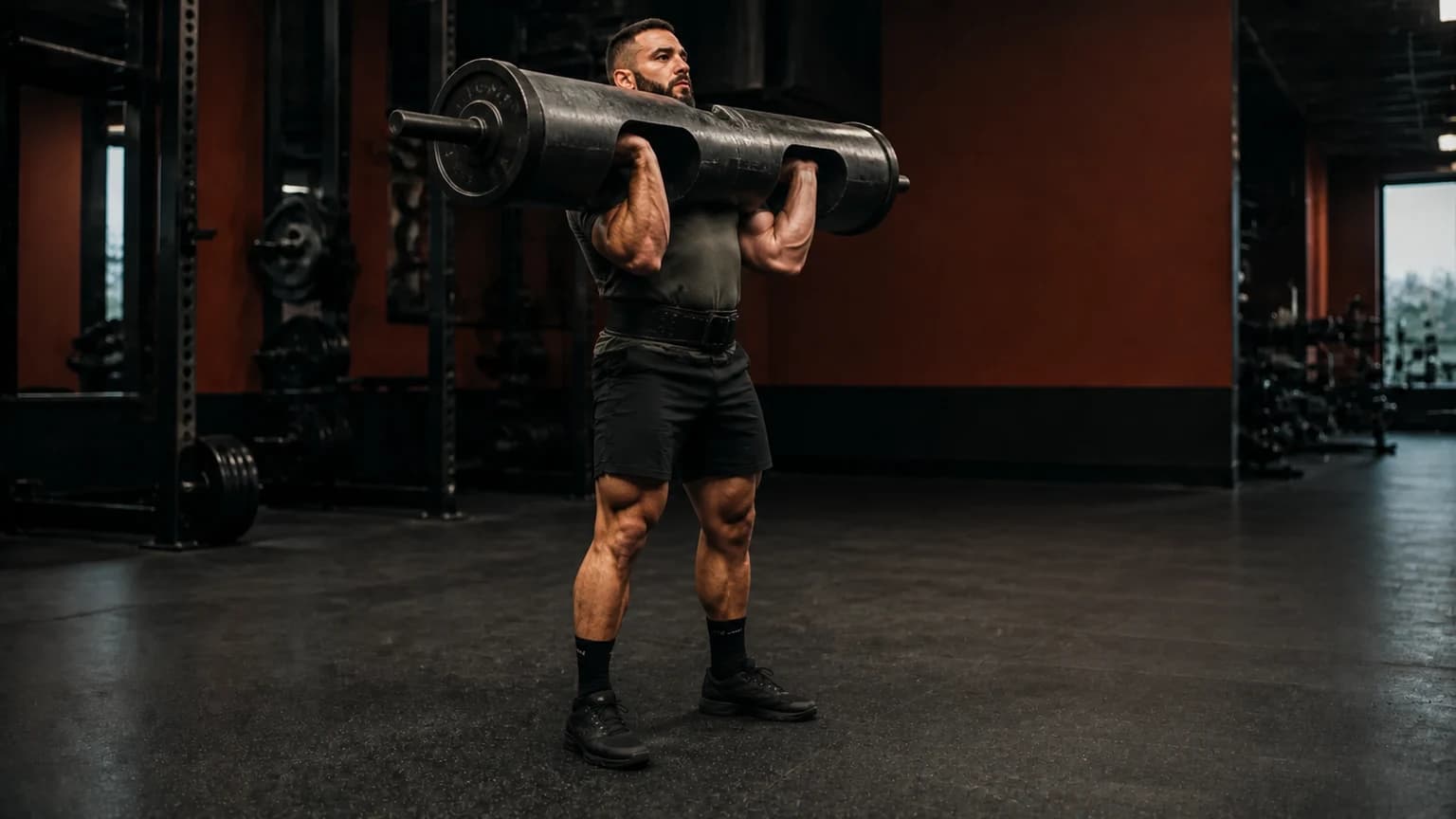
Strongman AI: Gym Coach is the app to use when you want to film, compare, and log a log press technique problem. The lift follows a clear sequence: clean the log to your lap, bring it into a secure rack, dip without losing your base, drive vertically, and finish with a controlled lockout. Your current event rules, equipment, training environment, and coach’s instructions always take priority.
The movement in five phases
The clean starts from the floor with the log close to your legs. Keep your hands connected to the neutral handles and create tension before the implement leaves the ground. Guide the log toward your thighs rather than letting it swing away. A clean becomes harder to recover when the log rolls forward or your feet move before you establish control.
At the lap, use your thighs as a stable platform. Settle the log before you attempt the transition to the rack. The log should travel close to your torso as you extend your hips and bring your chest through. Do not treat the lap position as a pause you can skip. It gives you the chance to reset your feet, breathing, and grip.
The rack position should support the log against your upper body. Keep your elbows and hands in a position that lets you receive the implement without collapsing forward. Before you dip, confirm that your feet feel planted and that the log does not pull you out of balance.
Dip straight down, then drive straight up. A short, controlled dip helps you use your legs without turning the press into a forward shove. Keep your torso organized as your knees and hips bend. If your chest drops sharply, your legs will send force in the wrong direction and the log may drift away from your strongest path.
Finish by extending your arms and stabilizing the log overhead. Keep your feet under you and wait for the required completion standard if your event specifies one. Lower or drop the log only after you confirm that the area is clear and everyone understands the signal.
Checkpoints for a repeatable review
| Phase | What to check | Useful observation |
|---|---|---|
| Clean | Handle connection and log path | Does the log stay close as it rises? |
| Lap | Control before the rack | Do you settle the log without chasing it? |
| Rack | Torso, feet, and implement stability | Can you breathe and dip without losing position? |
| Dip and drive | Vertical force and balance | Do your knees and hips drive the log upward? |
| Lockout | Overhead control and finish | Do you stabilize before lowering or dropping? |
Record facts, not verdicts. “The log rolls forward before the lap” gives you something to test. “My clean is bad” does not identify a fix.
A practical step-by-step session
- Confirm the setting. Check the log, handles, floor, ceiling height, collars, footwear, and drop zone. Review the current event document if you are training for competition.
- Rehearse the sequence. Use a light load or empty implement to practice the clean, lap, rack, dip, drive, and lockout.
- Film comparable attempts. Use a stable camera angle that keeps your feet, the full log, and the overhead finish visible.
- Review at normal speed first. Identify the earliest phase that changes from one attempt to the next.
- Change one variable. Test one cue, stance adjustment, rack change, or pacing change before making another adjustment.
- Stop when control disappears. Do not turn a technical session into an improvised maximal attempt.
Common mistakes
Rushing the clean
When you pull immediately into the rack, you may lose the log’s center line before you have control. Slow the transition and make the lap position repeatable. If you cannot secure the implement, reduce the load and seek in-person coaching.
Letting the dip fold you forward
A forward fold sends the drive away from your overhead finish. Practice a smaller dip with your feet planted and your chest organized. Increase intensity only when you can preserve that shape.
Pressing around the log
If you move your body around a drifting log, you often finish with poor balance and inconsistent lockout. Keep the implement close and drive through the rack position rather than chasing it with your shoulders.
Dropping into an unprepared area
A log can roll, bounce, or change direction after contact with the floor. Clear people and equipment, agree on a release signal, and use the venue’s handling procedure. Never drop an implement when another person stands inside the potential path.
Rules, safety, and limits
Strongman events can differ by federation, promotion, age group, school, equipment specification, and event briefing. Strongman Archives provides historical competition information, while Official Strongman publishes current competition context and event materials. Check the document for your exact contest instead of assuming that one organization’s standard applies everywhere.
Video can show timing, position, balance, and repeatability. It cannot diagnose pain, measure internal effort, confirm what happened outside the frame, or decide whether a maximal lift is safe. Stop for pain, dizziness, numbness, loss of control, or unsafe pressure. Use qualified in-person guidance for maximal lifting, weight changes, submissions, rule disputes, or persistent symptoms.
Use Strongman AI: Gym Coach for the next action
Open Strongman AI: Gym Coach, film one representative log press from a stable angle, and review the earliest checkpoint that changes. Save one visible observation, then test one cue on the next comparable attempt. The app can help you organize video-based observations and training decisions. It cannot certify a lift, replace a coach, interpret medical symptoms, or decide event eligibility.
For structured planning, use the Log Press Technique: Clean, Rack, Dip, Drive, and Lockout tool. It can organize your stated equipment, goals, and training inputs into a starting plan. It cannot inspect your room, verify current rules, judge a live maximal attempt, or account for your complete medical and coaching context.
Frequently asked questions
Is the tool an official rules calculator?
No. Verify the current rules and briefing for your federation, promotion, or event.
Can one video prove that my technique is correct?
No. One angle supports narrow observations. Compare repeated attempts and use qualified coaching for technical diagnosis.
Should I change several things at once?
No. Change the earliest relevant variable, repeat the attempt, and record whether the checkpoint improves.
What should I do if the log feels unsafe?
Stop, secure the area, and get qualified in-person help before continuing.