
Events
Husafell Stone Carry: Pick, Hold, Steps, Turns, and Rules
Learn how to prepare a Husafell-style carry, compare event rules, film the pick and turn, and progress without touching the original stone unprepared.
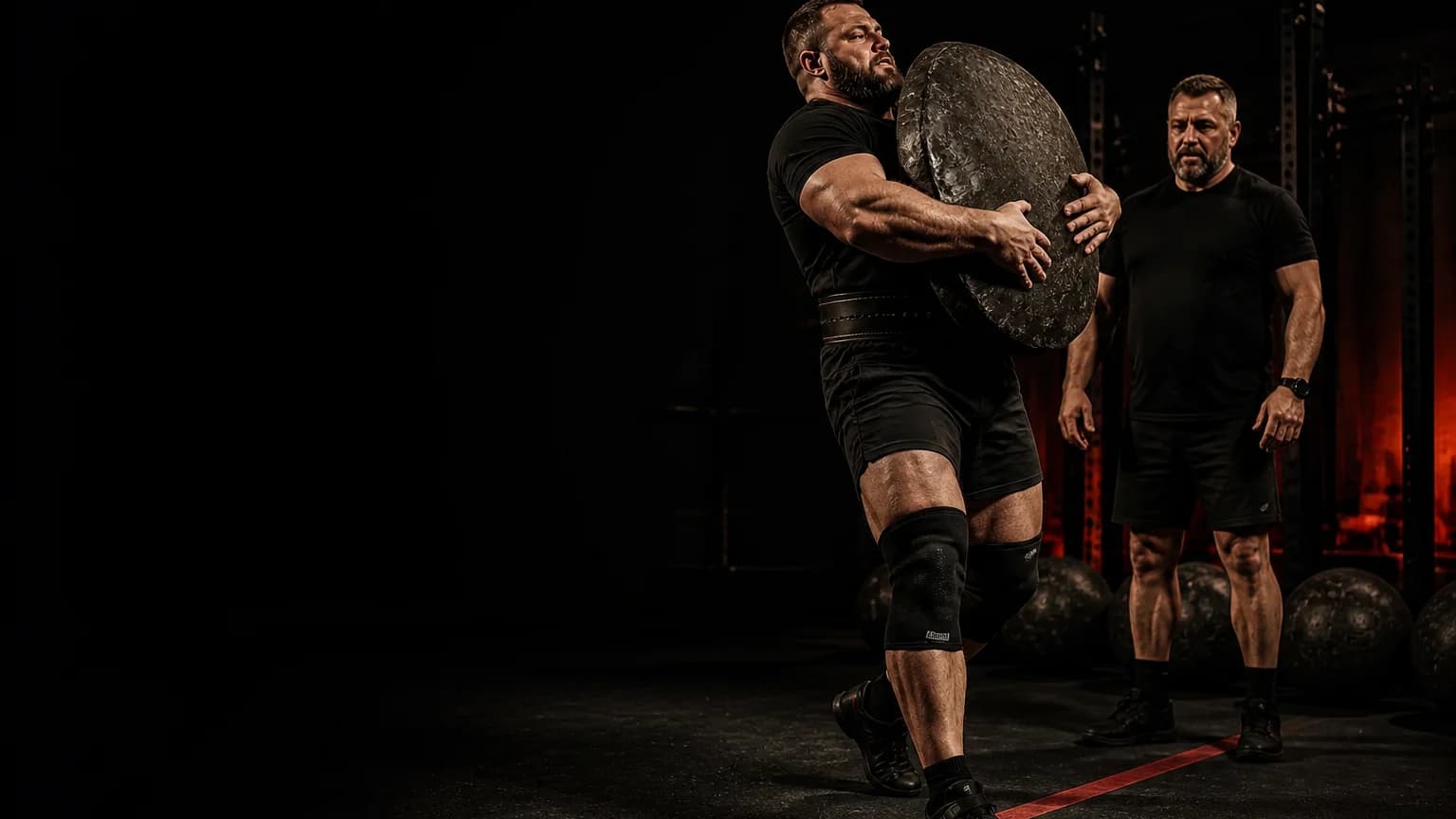
A Husafell carry asks you to pick a wide shield-shaped stone or implement, secure it high against the front of your body, walk a course, negotiate any required turns, and keep moving until you cross the finish or the implement touches the ground. Event rules vary. Some contests score time over a set distance, others score maximum distance, and organizers may change allowed grip, drops, tacky, belts, turns, and finish criteria.
Train with a purpose-built implement, suitable surface, clear course, and experienced strongman coach. Do not make the original Húsafell Stone in Iceland your first heavy natural-stone attempt.
Understand the implement and event
The original Húsafell Stone is a flat, irregular Icelandic lifting stone associated with the sheep pen at Húsafell. The World's Strongest Man event history describes a roughly 182-kilogram stone carried high across the chest.
Modern contests may use a replica, steel loadable shield, sandbag, or another front-carry implement. Ask the organizer for:
- exact implement and loaded weight;
- pickup height and starting position;
- course length and turn lines;
- time limit or maximum-distance method;
- whether drops end the attempt;
- allowed grip, belt, sleeves, chalk, and tacky;
- finish and distance-measurement rule.
Do not plan from the event name alone.
Review five phases
| Phase | Your task | Visible checkpoint |
|---|---|---|
| Setup | Choose foot and hand position around the implement | You can reach the grip without twisting into a trapped position |
| Pick | Bring the implement to the lap or directly upward as coached | The load stays close and the course remains clear |
| Secure | Raise and clamp the implement against the torso | You can breathe and see the route |
| Carry | Use short repeatable steps | The load does not slide lower on every step |
| Turn and finish | Cross the line or reverse direction under the stated rules | Both feet and the implement satisfy the organizer's finish rule |
Build a safe pickup
Wedge your hands and forearms around the implement according to its shape. A natural stone can expose fingers to sharp edges and shifting load, while a steel shield or sandbag changes the grip.
Use a staged pick when appropriate: raise the implement to the lap, reset your hands and torso, then stand. Some contest setups demand a direct pick. Practise the exact version you will face.
Keep your feet clear of the drop zone. Agree on commands with spotters, and never let someone place hands beneath a suspended stone.
Secure the hold without losing your route
Bring the implement high enough to reduce the lever pulling you forward, but not so high that you cannot see the course or breathe. The rulebook may limit contact points. For example, World Strongman's standardized Husafell sandbag carry permits chest and stomach contact in its relay format: review the event description.
The original stone, a replica, and a sandbag do not create identical demands. Practise on the implement you can control, then adapt under coaching.
Walk with short deliberate steps
Accelerate only after you establish the hold. Keep each step under the combined center of mass and avoid a long reaching stride. When the implement begins sliding, do not blindly squeeze harder while your position collapses. Know the event's safe drop procedure and use it.
Train straight courses before turns. Record distance and load separately so you can tell whether you improved the pick, the carry, or both.
Turn according to the line rule
A turn can decide the event. Some organizers require a foot to cross a line before you turn. Others measure around a marked object or specify that the implement itself must cross. Read the written rule and ask questions at the athlete briefing.
Shorten the steps before the line, keep the load close, rotate through several controlled steps, and accelerate only after you face the new direction. Do not spin on one planted foot under a maximal load.
Film the whole course safely
Use a fixed side-oblique camera for the pickup, first steps, and load position. Use a second distant camera for the turn and finish only if it remains outside the course and spotter lanes.
Do not let a camera operator walk backward in front of a loaded athlete. The athlete needs an unobstructed route and a clear place to drop.
Correct the first limiting phase
| What you see | What to test |
|---|---|
| Pick stalls below the lap | Lighter load, starting height, and hand position |
| Implement sits too low | Rehearse the transition from lap to secure hold |
| You cannot see the course | Lower the hold or use a safer implement under coaching |
| Steps reach far ahead | Shorten the stride before adding speed |
| Load slips at the turn | Slow before the line and practise the turn separately |
| You drop near your feet | Rehearse the designated drop and exit path unloaded |
Build the event progressively
Start with bear-hug carries, sandbags, or a light loadable shield that lets you practise the pick and breathing. Increase one variable at a time: load, distance, speed, turn difficulty, or fatigue. Keep enough recovery to repeat the technique.
Review farmer's walk technique, atlas stone technique, and strongman training in a regular gym for related event preparation.
Stop for sharp pain, numbness, dizziness, chest symptoms, or loss of control. Ask a qualified clinician about symptoms and a qualified coach about loading.